
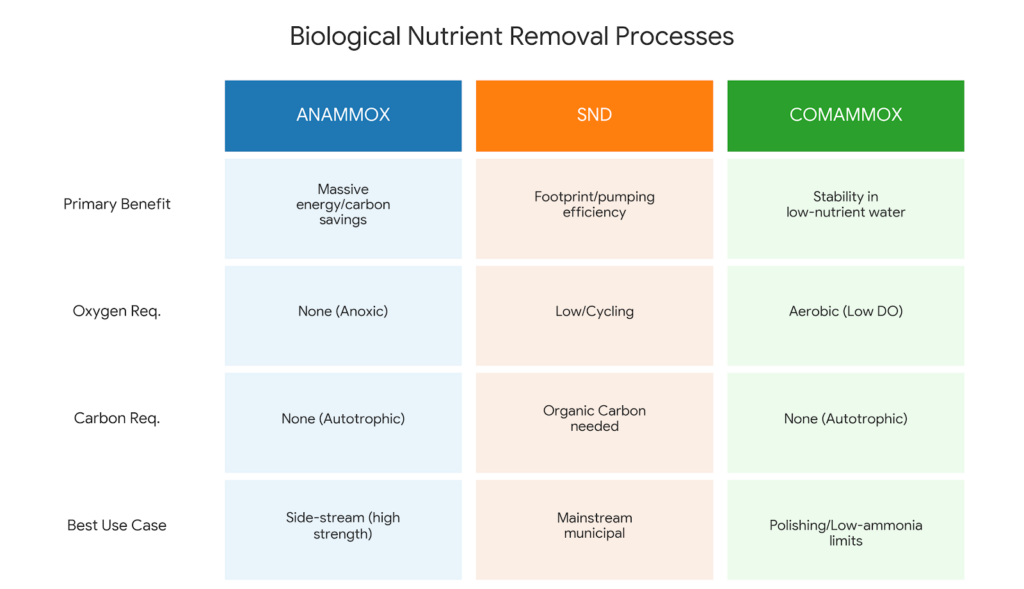
For decades, wastewater treatment has relied on the traditional “Bardenpho” approach: Nitrification followed by Denitrification. While reliable, this process is energy-intensive and often requires costly external carbon sources.
As we push toward “Net Zero” and more sustainable plant operations, new biological pathways are changing the game. Today, we’re diving into three technologies—ANAMMOX, SND, and COMAMMOX—to understand how they work and why they matter for your facility.
ANAMMOX (Anaerobic Ammonium Oxidation)
ANAMMOX represents one of the most significant shifts in wastewater microbiology. Unlike traditional denitrification, which requires organic carbon (like methanol), ANAMMOX bacteria convert ammonium and nitrite directly into nitrogen gas under anoxic conditions.
- The Shortcut: In a process often called “Deammonification,” only half of the ammonium is converted to nitrite (partial nitritation). The ANAMMOX bacteria then take that nitrite and the remaining ammonium to produce $N_2$ gas.
- The Benefits:
- 60% reduction in aeration energy.
- 100% reduction in external carbon demand.
- Significant reduction in sludge production.
Pro-Tip: ANAMMOX bacteria are “slow growers.” Maintaining the right temperature and protecting the biomass from washout (often via granular sludge or biofilm media) is critical for success.
SND (Simultaneous Nitrification-Denitrification)
SND isn’t necessarily a specific “species” of bacteria, but rather a process where nitrification and denitrification occur at the same time in the same tank.
- The Mechanism: This relies on micro-environments. In a single floc or biofilm, the outer layer is aerobic (promoting nitrification), while the inner core is oxygen-depleted or anoxic (promoting denitrification).
- The Benefits:
- Eliminates the need for separate internal mixed-liquor recycle (IMLR) pumping.
- Alkalinity Recovery: The alkalinity produced during denitrification is immediately available for nitrification, helping to stabilize pH.
- Reduced footprint by combining zones.
COMAMMOX (Complete Ammonia Oxidation)
For over a century, we believed nitrification was a two-step relay race: Nitrosomonas turned ammonia into nitrite, and Nitrospira turned nitrite into nitrate. In 2015, we discovered COMAMMOX—organisms that can do the whole job alone.
- The “All-in-One” Specialist: COMAMMOX bacteria (specifically certain strains of Nitrospira) possess the enzymes for both steps of nitrification.
- Why it Matters: COMAMMOX bacteria often have a high affinity for ammonia, meaning they can thrive in low-nutrient environments where others struggle.
- They are highly efficient, potentially allowing for more stable nitrification in plants with low ammonia targets or those operating at low dissolved oxygen (DO) levels.
The Bottom Line
The future of wastewater isn’t just about moving water; it’s about managing microbial niches. Whether you are looking to shave 20% off your energy bill with SND or go carbon-neutral with ANAMMOX, understanding these pathways is the first step toward a more efficient facility.