
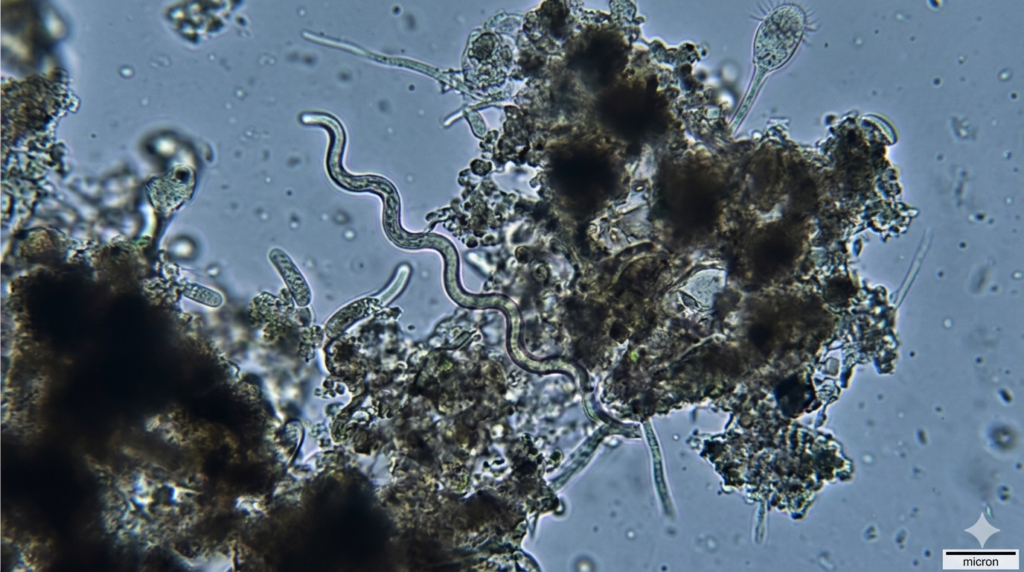
Spirillum are corkscrew shapped. small fast moving organisms seen with low DO and high organic acids – AKA septicity.
When you look at activated sludge under the microscope, you usually focused on the big players— metazoa, protozoa, floc size/density, and the filamentous organisms that can make or break settling performance. But sometimes the most important clues come from the small and easily overlooked organisms. Spirillum, the fast‑moving, spiral‑shaped bacteria, fall squarely into that category.
They aren’t major contributors to treatment. They don’t build floc. They don’t remove ammonia.
But they are powerful indicators of what’s happening inside your biology.
At Aster Bio, we pay close attention to these early‑warning organisms because they often show up before operators see process upsets, bulking, or odor issues. Here’s what spirillum can tell you about your system—and why they matter more than most people realize.
What Are Spirillum?
Spirillum (and the broader group of spirochetes) are highly motile, spiral‑shaped bacteria that move with a corkscrew motion. They thrive in environments rich in organic acids and low dissolved oxygen (DO)—conditions that are common in systems experiencing upstream septicity or oxygen stress.
Unlike floc‑forming bacteria, spirillum do not contribute to biomass structure or settling. Their value lies in what they indicate.
What Spirillum Reveal About Biological Conditions
1. Low Dissolved Oxygen (DO) Stress
Spirillum thrive when oxygen is limited. Their presence often signals that the system is operating under oxygen deficit, even if bulk DO readings look acceptable.
Common causes include:
- Aeration systems not keeping up with organic loading
- Poor mixing creating anoxic pockets
- Thick, dense floc with anoxic cores
- High respiration rates from shock loads
Why it matters:
Low DO is one of the earliest drivers of filamentous bulking and poor settling. Spirillum are often the first organisms to respond.
2. High Organic Acids and Septicity
Spirillum feed on volatile fatty acids (VFAs) and fermentation products. When they appear in significant numbers, it’s a strong sign that the biomass is receiving partially fermented wastewater with high organic acids.
This can originate from:
- Long detention times in primary clarifiers
- Septic lift stations or force mains
- Industrial influent rich in organic acids
- Return streams with reduced compounds (e.g., digester supernatant)
Why it matters:
Organic acids shift the microbial community toward fermenters and filaments, destabilizing floc and reducing treatment efficiency.
3. Early Warning of Filamentous Bulking
Spirillum often appear before classic septicity‑associated filaments such as:
- Thiothrix
- Type 021N
- Beggiatoa
Their presence is an early biological signal that conditions are trending toward filament growth.
Why it matters:
Catching these shifts early allows operators to correct conditions before bulking impacts clarifier performance.
How to Interpret Spirillum in Microscopy
| Spirillum Observation | What It Means | Operational Takeaway |
|---|---|---|
| Rare / occasional | Minor DO dips or mild acid load | Continue monitoring |
| Common throughout sample | Chronic low DO or persistent organic acids | Check aeration, mixing, upstream septicity |
| Abundant + odors or black solids | Strong fermentative conditions | High risk of filament bulking |
| Present in selectors | Selector DO too low or too acidic | Increase DO or shorten HRT |
What Operators Can Do When Spirillum Increase
If spirillum begin to appear consistently, it’s time to investigate system conditions:
Improve Oxygen Transfer
- Increase aeration
- Verify blower performance
- Reduce floc thickness through wasting
Eliminate Anoxic Pockets
- Improve mixing
- Check for dead zones in basins or channels
Reduce Septicity Upstream
- Shorten primary clarifier detention time
- Inspect lift stations and force mains
- Manage industrial loadings
Stabilize Return Streams
- Evaluate digester supernatant or sidestream impacts
- Consider step‑feed to dilute high organic acid loads
The Bottom Line
Spirillum are not treatment workhorses—they’re an early warning system.
Their presence signals low oxygen, high organic acids, or upstream septicity, all of which can destabilize floc and set the stage for filamentous bulking.
By paying attention to these early indicators, operators can take proactive steps to stabilize biology before performance declines.
At Aster Bio, our Environmental Genomics™ and MCA testing help facilities catch these shifts early—long before they show up in clarifiers or effluent quality. Spirillum are just one piece of the biological puzzle, and we help operators see the whole picture.