
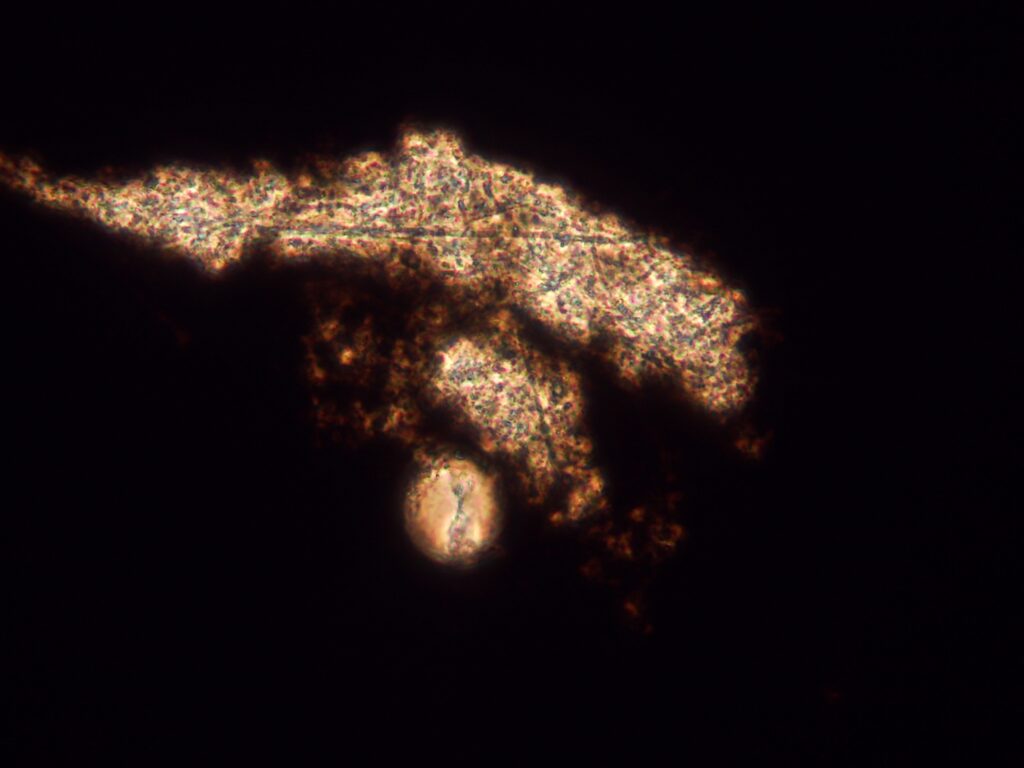
India Ink does not penetrate EPS. This allows for rapid evaluation of floc for LB vs TB EPS and potential non-filamentous bulking.
In every activated sludge system, the quality of your solids handling comes down to one thing: how well your biomass sticks together. Operators often focus on filaments, MLSS, or clarifier hydraulics when troubleshooting settling issues — but the real story is often hidden in the extracellular polymeric substances (EPS) that hold floc together.
EPS isn’t just slime. It’s the structural backbone of activated sludge, and its composition determines whether your floc efficiently settles and compacts.
To understand settling and compaction, you need to understand the two major EPS fractions: Loosely Bound EPS (LB‑EPS) and Tightly Bound EPS (TB‑EPS).
What Are LB‑EPS and TB‑EPS?
Loosely Bound EPS (LB‑EPS)
LB‑EPS forms the outer, more hydrated, more viscous layer around floc particles.
Characteristics
- High water content
- Weak attachment to cell surfaces
- Easily sheared off
- Rich in proteins, polysaccharides, and soluble microbial products (SMPs)
Functional role LB‑EPS acts like a hydrated cushion around floc. It protects cells but also traps water — which is exactly why too much LB‑EPS leads to fluffy, low‑density sludge – also known as non-filamentous bulking or viscous bulking.
Tightly Bound EPS (TB‑EPS)
TB‑EPS forms the inner, dense, cohesive matrix that gives floc its strength and structure.
Characteristics
- Strongly attached to cell walls
- Lower water content
- More compact and stable
- Critical for floc integrity and density
Functional role TB‑EPS is the glue that creates dense, well‑settling floc. Systems with strong TB‑EPS tend to have excellent compaction and low SVI.
Why the Balance Between LB‑EPS and TB‑EPS Matters
The ratio of LB‑EPS to TB‑EPS determines how your sludge behaves in the clarifier.
Here’s the simple rule:
More LB‑EPS = fluffier floc, slower settling, poor compaction
More TB‑EPS = denser floc, faster settling, better compaction
How LB‑EPS Impacts Settling and Compaction
When LB‑EPS dominates, sludge becomes:
1. Fluffy and Hydrated
LB‑EPS traps water, increasing the effective volume of the floc. This leads to:
- High SVI
- Slow settling velocities
- Thick sludge blankets
2. Prone to Shear and Deflocculation
Because LB‑EPS is weakly attached:
- Floc breaks apart easily
- Effluent TSS increases
- Clarifiers lose solids faster during peak flows
3. Difficult to Dewater
High LB‑EPS = high bound water = high polymer demand.
4. Common in Low F/M or Aged Sludge
Winter operations, long SRTs, and carbon‑limited conditions all push microbes to overproduce LB‑EPS.
How TB‑EPS Improves Settling and Compaction
When TB‑EPS is strong, sludge behaves like a well‑engineered material:
1. Dense, Cohesive Floc
TB‑EPS creates a compact internal matrix, improving:
- Settling velocity
- Clarifier capture efficiency
- Sludge blanket stability
2. Better Compaction
More TB‑EPS means:
- Lower sludge volume index (SVI)
- Higher solids concentration in the RAS
- Better thickening and dewatering
3. Resistance to Shear
Strong TB‑EPS protects floc from:
- Hydraulic shocks
- Aeration turbulence
- High‑flow events
4. Common in Balanced, Healthy Systems
Stable F/M, adequate nutrients, and moderate SRTs promote TB‑EPS formation.
What Causes Imbalances in EPS?
Several operational factors shift the LB‑EPS : TB‑EPS ratio:
| Condition | EPS Impact | Result |
|---|---|---|
| Low F/M | ↑ LB‑EPS | Bulking, poor settling |
| Long SRT / Aged sludge | ↑ LB‑EPS | Weak floc, high effluent TSS |
| Nutrient deficiency (N/P) | ↑ LB‑EPS | Slimy floc, poor compaction |
| Toxic shocks | ↑ LB‑EPS | Stress response, deflocculation |
| Stable loading & nutrients | ↑ TB‑EPS | Dense, well‑settling sludge |
| Balanced SRT | ↑ TB‑EPS | Strong floc structure |
How EPS Drives Clarifier Performance
Settling Velocity
- LB‑EPS increases drag → slow settling
- TB‑EPS increases density → fast settling
Compaction
- LB‑EPS retains water → poor compaction
- TB‑EPS squeezes out water → tight sludge blanket
RAS Concentration
- LB‑EPS → low RAS solids
- TB‑EPS → high RAS solids
Dewatering
- LB‑EPS → high polymer demand
- TB‑EPS → easier dewatering
How Operators Can Influence EPS Balance
You can’t measure EPS every day, but you can manage the conditions that control it.
1. Control SRT
Avoid excessively long sludge ages that favor LB‑EPS.
2. Maintain a Healthy F/M
Low F/M = EPS overproduction. Adjust wasting to keep biomass active.
3. Ensure Adequate Nutrients
Carbon‑rich, nutrient‑poor influent drives LB‑EPS formation.
4. Avoid Toxic or Shock Loads
Stress increases LB‑EPS and destabilizes floc.
5. Improve Aeration Stability
DO swings can shift EPS composition and floc structure.